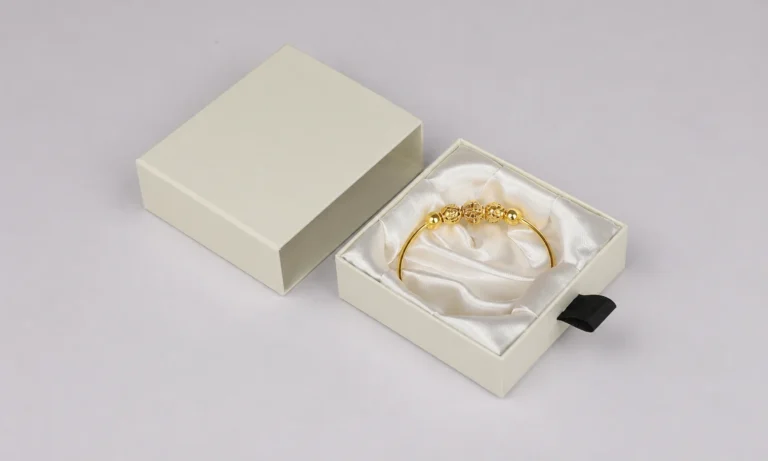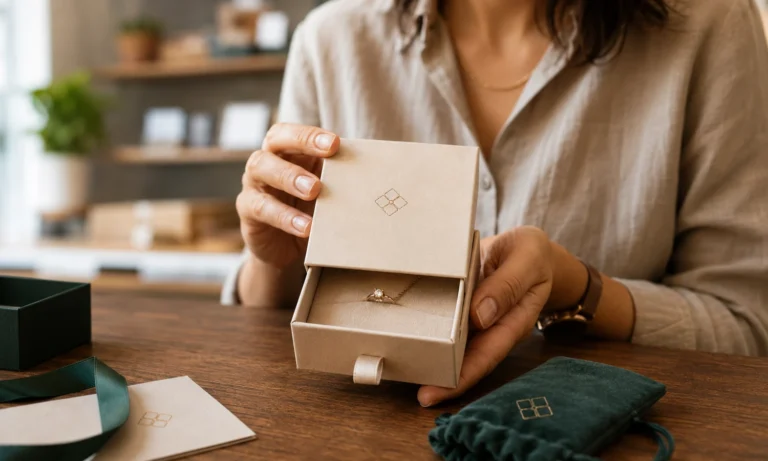
Drawer vs Magnetic vs Hinged Jewelry Boxes: A Buyer’s Comparison

Drawer, magnetic, and hinged jewelry boxes can all create a polished presentation. The important difference is not which one looks most luxurious in a photograph. It is how each structure opens, holds the jewelry, fits the sales channel, supports branding, affects the packing process, and works inside the complete storage or shipping system.
A drawer box can create a gradual reveal, but the tray must slide smoothly and remain easy to grip. A magnetic box can provide a defined closing action and a broad outer panel, but the location and strength of the closure need to suit the box and its contents. A hinged box keeps the lid connected, which can help with display and handling, but the open angle, hinge behavior, and interior clearance must be tested.
There is also an important terminology issue: magnetic describes a closure method, while hinged describes how the lid is connected. A flip-top magnetic box may also have a hinged lid. Suppliers and buyers do not always use these labels in exactly the same way. Before comparing quotations, confirm each structure with an opening video, a simple construction drawing, and a physical sample.
The best jewelry box style is therefore the one that supports the product and the real workflow—not the one with the most fashionable name.
Drawer vs Magnetic vs Hinged Jewelry Boxes: The Quick Comparison
Use this table as a discussion guide, not as a universal specification. Exact performance depends on the dimensions, materials, insert, closure, construction, and production method.
| Buyer consideration | Drawer jewelry box | Magnetic jewelry box | Hinged jewelry box |
|---|---|---|---|
| Basic opening action | An inner tray slides out of an outer sleeve | A flap or lid opens after a magnetic closure is released | A connected lid rotates around a hinge or flexible joint |
| Typical reveal | Gradual or staged | Direct, with a defined opening and closing action | Direct, with the lid remaining attached |
| Main handling question | Can the tray be opened and closed smoothly without pulling too hard? | Is the closure easy to locate, open, align, and close consistently? | Does the lid open to the intended angle and remain stable during use? |
| Interior planning | Tray depth, pull access, sleeve clearance, and insert position | Lid thickness, closure position, insert clearance, and flap movement | Hinge zone, lid clearance, insert depth, and display angle |
| Branding opportunities | Outer sleeve, tray front, top panel, belly band, or interior reveal | Large exterior or flap panels, top surface, and interior lid | Top lid, inner lid, front edge, and other visible panels |
| Packing workflow | May involve sliding the tray out, loading, checking alignment, and closing the sleeve | Often a direct open-load-close sequence, depending on construction | Often a direct open-load-close sequence with the lid attached |
| Display behavior | Tray can be partly or fully extended; sleeve may remain beside it | Open lid or flap may become part of the presentation | Connected lid can frame the jewelry when the box is open |
| Storage and transport | Compare assembled dimensions, sleeve fit, tray movement, and packing orientation | Compare assembled volume, magnet components, lid movement, and outer protection | Compare assembled volume, hinge or hardware, open-lid geometry, and outer protection |
| Best starting point for | Brands seeking a controlled reveal or layered presentation | Brands seeking a clear closure action and broad presentation surfaces | Brands seeking an attached lid and stable open-box presentation |
None of these structures is automatically better, cheaper, more sustainable, or more premium. Those conclusions require a project-specific comparison using the same jewelry, dimensions, materials, insert requirements, branding, quantity, and shipping assumptions.
First, Confirm What the Supplier Means by Each Structure
Packaging names are useful for browsing, but they are not always precise enough for production. Two suppliers may use “magnetic box” for different constructions. One may mean a rigid book-style box with concealed magnets in the flap. Another may mean a flip-top presentation box with a magnetic catch. A product described as a hinged box may use a flexible paper hinge, fabric hinge, metal hinge, or another connected-lid construction.
The same overlap appears in product catalogs. A hinged box can use magnets to stay closed. A drawer box can include a ribbon pull, thumb notch, friction fit, or stop. A “flip-top” box may be described as hinged, magnetic, or both.
To compare like with like, ask for:
- closed, 45-degree-open, and fully open photographs;
- a short opening and closing video at normal speed;
- exterior and interior dimensions;
- a side view or simple cross-section showing the lid, sleeve, tray, joint, and closure;
- the insert depth and the clearance above the jewelry;
- the material and component description;
- an explanation of whether the sample is structurally identical to the quoted version.
The name can start the conversation. The sample and written specification should settle it.
Drawer Jewelry Boxes: A Controlled, Layered Reveal
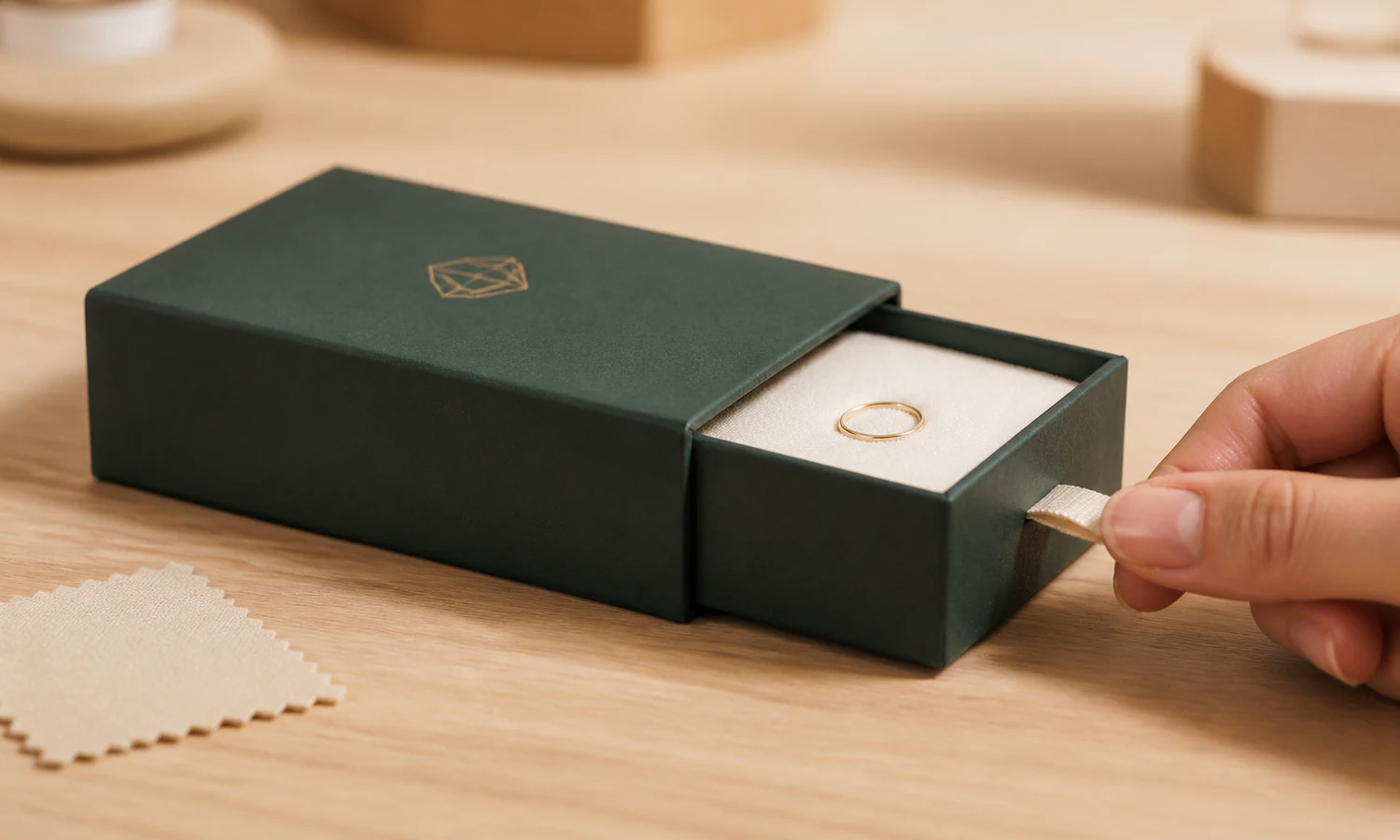
A drawer jewelry box usually combines an outer sleeve with an inner tray. The customer pulls the tray outward using a ribbon, tab, notch, exposed front edge, or another grip point. The jewelry is presented inside the tray, often after a short opening sequence rather than in one immediate movement.
This staged action can suit brands that want the customer to slow down and reveal the piece gradually. The outer sleeve can also create a separate branding surface, while the tray front or interior can carry a second detail.
What drawer boxes can do well
Drawer construction can be useful when the packaging concept benefits from:
- a deliberate pull-out reveal;
- separation between the outer sleeve and the inner presentation tray;
- branding across several visible surfaces;
- a rectangular form that can coordinate across a product range;
- an interior tray that can be developed around a fitted insert.
The sliding action is part of the experience, so it should feel intentional rather than accidental. A tray that is too loose may move when the box is tilted. A tray that is too tight may be frustrating to open or may cause the user to pull sharply on a ribbon or tab.
What to test on a drawer-box sample
Open and close the sample repeatedly in the orientation the customer will use. Check whether the tray begins moving smoothly, stays aligned, and closes without catching the sleeve. Test the box when it is empty and when the actual jewelry, insert, cards, and accessories are inside.
Also review:
- whether the grip point is easy to understand;
- whether a ribbon, tab, or notch is comfortable to use;
- whether the tray can slide out farther than intended;
- whether the sleeve or tray edges show rubbing after repeated use;
- whether the insert stays centered as the tray moves;
- whether the jewelry remains in its approved position during normal handling;
- whether staff can pack and close the box without extra adjustment.
A dramatic pull-out photograph does not prove the everyday opening action. Judge the full movement at normal speed.
Magnetic Jewelry Boxes: A Defined Closure, Not One Single Box Type
“Magnetic jewelry box” usually refers to a structure that uses concealed or visible magnetic components to help keep a lid or flap closed. The exact construction may be book-style, flip-top, folding, rigid, or another format. This is why the drawing and opening video matter more than the product label.
A magnetic closure can provide a clear moment when the box aligns and closes. Broad lid or flap panels may also create useful space for a logo, pattern, message, or interior presentation. However, the magnetic action should support the design rather than become the only reason to choose the box.
What magnetic boxes can do well
Depending on the construction, a magnetic format can support:
- a direct opening sequence with a defined closing action;
- wide exterior or interior panels for branding;
- book-style or flip-top presentation;
- a connected package that does not require a separate lid;
- coordinated presentation for jewelry, cards, and supporting brand elements.
The term “magnetic” does not by itself confirm the quality, strength, alignment, durability, recyclability, or safety of the complete package. These points must be reviewed for the intended construction and market.
What to test on a magnetic-box sample
Check whether the closure finds the correct position without twisting the lid or forcing the user to realign the edges. Open the box with one and two hands. Observe where the fingers naturally go and whether the jewelry or interior surface is touched during opening.
Review:
- whether the closure is too weak, too strong, or suitable for the intended use;
- whether the lid sits evenly when closed;
- whether the closure area creates visible marks, bulges, or misalignment;
- whether cards, thicker inserts, or raised jewelry interfere with closing;
- whether repeated opening changes the alignment or surface appearance;
- whether the magnet and related components are identified in the material specification;
- whether any disposal, recycling, or market-specific claim is supported for the complete package.
Do not approve the closure by sound alone. The edges, lid position, interior clearance, and repeated action matter more than a dramatic closing effect.
Hinged Jewelry Boxes: Connected-Lid Presentation and Display
A hinged jewelry box has a lid that remains connected to the base as it opens. The connection may use a flexible wrapped joint, fabric, a mechanical hinge, or another construction. Traditional ring, earring, necklace, bracelet, and watch boxes often use some form of connected lid, but the exact opening angle and interior geometry vary.
The attached lid can make the open box feel like one complete presentation object. It can also provide a consistent interior-lid area for a logo or message. For retail counters, appointments, proposals, gifting, or photography, the lid can frame the jewelry—provided that it opens to the intended angle and remains stable.
What hinged boxes can do well
Hinged construction can be a useful starting point when the brand needs:
- a lid that stays with the base during handling;
- a compact opening sequence without removing a separate lid;
- an open-box display angle;
- an inner-lid branding area;
- a familiar presentation format for rings, earrings, pendants, bracelets, or watches.
The connected lid does not automatically make the box more durable. Durability depends on the joint, covering material, hardware where used, repeated opening, assembly, and handling conditions.
What to test on a hinged-box sample
Open the box slowly and let the lid rest at its intended angle. Confirm whether it stays stable on the relevant surface or pulls the base backward. Test the box with the actual insert and jewelry, because a top-heavy lid or tight joint may behave differently when the box is loaded.
Check:
- the fully open angle and whether a stop or natural limit is present;
- whether the hinge area wrinkles, stretches, rubs, or exposes an unfinished edge;
- whether the lid stays aligned when closed;
- whether the interior lid touches raised jewelry, cards, or accessories;
- whether the box remains stable for retail display or photography;
- whether the user can remove the jewelry without the lid falling forward;
- whether the joint performs consistently after repeated opening.
For a product-level reference, buyers can view a textured paper hinged necklace box while keeping in mind that one example does not define every hinged construction.
Compare the Opening Experience With the Sales Channel
The opening sequence should make sense for where the customer encounters the packaging. A structure that works well during a slow gifting moment may not be the most efficient choice for a busy retail counter or a packing station handling many orders.
E-commerce and unboxing
For direct-to-consumer orders, the presentation box is only one layer of the experience. It still needs appropriate protection inside an outer shipping package. A drawer can create a staged reveal, while a magnetic or hinged lid can provide a direct opening action. The right choice depends on the desired sequence, content arrangement, and the way the presentation box fits inside the mailer or shipping carton.
Test the full pack-out, not only the jewelry box on a studio table. Check movement, abrasion, compression, orientation, and the ease of removing the presentation box from its protective layers. A presentation insert and a satisfying closure do not prove shipping performance.
Retail counter and boutique display
A hinged box can keep the lid attached while a sales associate presents the piece. Some magnetic flip-top formats can provide similar behavior. A drawer may work when the pull-out reveal is part of the service experience, but the outer sleeve and tray need a clear place on the counter.
Ask staff to demonstrate the product using the sample. Observe whether they need both hands, whether the lid or sleeve blocks the customer’s view, and whether the jewelry remains correctly aligned after repeated handling.
Gifting, appointments, and special presentations
The opening moment may carry more emotional weight in gifting or appointment-based sales. A gradual drawer reveal, a magnetic flap, or an upright hinged lid can all work. The better option is the one that supports the jewelry, the presenter’s hand movement, and the intended viewing angle without creating awkward extra steps.
High-throughput packing
For a busy e-commerce or retail operation, count the actions required to open, load, check, add cards, close, and place the box into its next packaging layer. A small structural inconvenience repeated across many orders can affect consistency and training.
Time several team members rather than relying on the designer’s familiarity with the sample. Record misalignment, rework, and hesitation as well as speed.
The Insert Must Be Developed With the Box Structure
The outer box and insert are one system. A deep ring setting, long earring drop, necklace chain, rigid bangle, or watch cushion can change the required cavity, access point, and lid clearance.
In a drawer box, the insert must remain stable while the tray moves through the sleeve. In a magnetic box, the insert and jewelry must not interfere with the closure or lid. In a hinged box, the product and insert must fit beneath the closing arc and remain clear of the interior lid.
Review the actual jewelry rather than an empty cavity. Confirm:
- the product’s maximum height, width, length, and weight where relevant;
- the pressure points and surfaces that should not contact the insert;
- the orientation when the customer first sees the jewelry;
- the finger access or pull feature needed for removal;
- the clearance above raised settings, pendants, posts, or watch components;
- the effect of cards, care guides, certificates, and accessories;
- the smallest, largest, and most difficult SKUs expected to share the box.
If one box will serve several jewelry types, decide whether a modular insert, separate insert versions, or different box sizes will give the most consistent result. Do not force a wide product range into one cavity simply to preserve an exterior size.
Buyers can compare the broader range of custom jewelry boxes while treating product fit, insert design, and opening action as linked decisions.
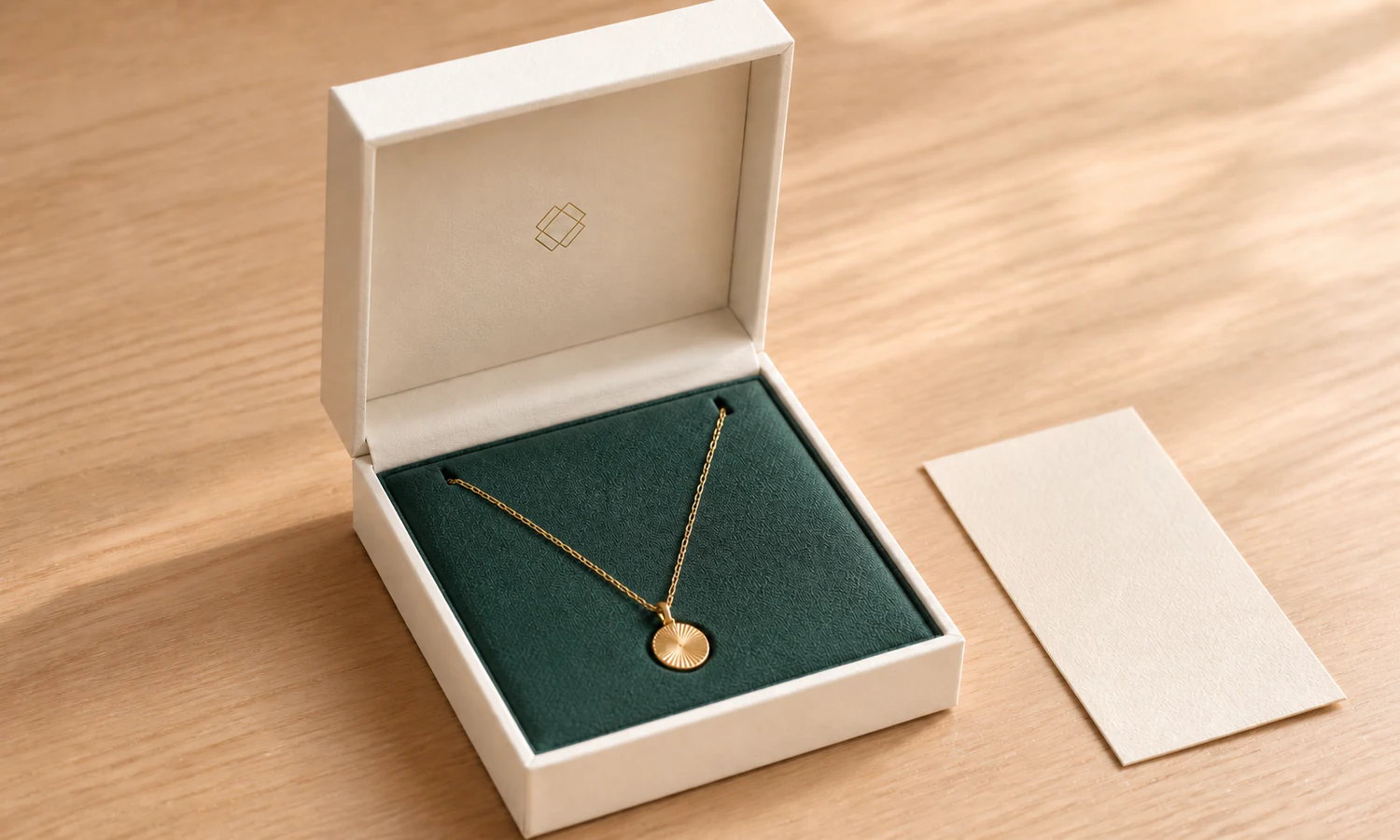
Branding Area Depends on What the Customer Sees and Touches
Every structure creates different visible surfaces and transitions. The correct logo placement is not necessarily the largest available panel.
Drawer-box branding
The outer sleeve is usually visible first. The tray front, pull tab, inner tray, tissue, card, or insert can create secondary brand moments. If the logo appears on both the sleeve and tray, define their scale and relationship rather than repeating the same mark without purpose.
Check whether the pull area interrupts the logo and whether rubbing at the sleeve edge can affect a finish placed too close to the opening.
Magnetic-box branding
Magnetic formats may provide broad exterior and interior panels. Logo placement should account for flap edges, closure components, fold or hinge lines, and the natural finger position during opening. A mark placed exactly where the customer presses the flap may show wear differently from a logo on a protected area.
Hinged-box branding
The top lid and inner lid are common branding areas. The outer mark supports recognition when the box is closed; the inner mark becomes part of the product presentation when open. Test the inner logo at the real display angle and viewing distance. A subtle tonal finish may disappear when the lid is upright or photographed under flat light.
For any structure, supply vector artwork, final logo dimensions, placement measurements, finish references, and the intended viewing conditions. Approve branding on the actual construction and material—not on an unrelated flat swatch.
Packing Workflow: Count the Actions, Not Just the Components
A buyer may approve a box after opening it once, while the operations team has to pack it repeatedly. Include the packing team before the structure is final.
Run a short packing trial with the intended sequence:
- Open the empty box.
- Load or secure the jewelry in the insert.
- Add any card, certificate, care guide, pouch, or accessory.
- Check product alignment and presentation.
- Close the box.
- Add the protective sleeve, tissue, bag, mailer, or shipping carton.
- Reopen a finished pack to confirm the customer experience.
Record where users pause, touch the jewelry, realign the insert, fight the closure, or repeat a step. The most suitable structure should help different team members achieve the approved presentation consistently.
Storage and Shipping Volume Need a Real Pack-Out Comparison
Do not assume that one named structure always saves more space. Finished dimensions, wall thickness, insert depth, lid geometry, sleeve construction, closure components, and protective packing all affect storage and shipping.
Ask each supplier to provide:
- finished exterior dimensions and weight for the quoted version;
- the way units are packed for delivery;
- units per inner pack and outer carton where available;
- outer-carton dimensions and gross weight for the proposed order configuration;
- whether boxes arrive assembled, partially assembled, or flat where the structure allows;
- protective layers used to prevent rubbing, crushing, or surface marking;
- pallet or warehouse assumptions where relevant to the order.
Then compare the complete system. A box with a compact footprint may still need more protective space. A format that can ship flat may require additional assembly time. A dense presentation box may reduce product movement but increase material and freight weight. These are project-specific trade-offs, not fixed rules.
Cost: Compare the Same Specification Before Ranking Structures
There is no reliable universal price order for drawer, magnetic, and hinged jewelry boxes. A simple hinged paper box and a rigid hinged presentation case are not the same product. A folding magnetic box and a fully assembled rigid magnetic box may have different materials, components, assembly, and shipping needs.
For a fair quotation comparison, keep the following inputs consistent:
- finished exterior and interior dimensions;
- board, paper, fabric, leather-like material, wood, or other construction;
- insert construction and covering;
- logo method, size, number of positions, and finish;
- closure, hinge, ribbon, tab, hardware, and accessories;
- estimated quantity and version count;
- sample scope and revision assumptions;
- individual protection, inner packing, and outer carton;
- destination and delivery requirements.
Ask suppliers to identify which variables change the quote. Unit price without the underlying specification is not enough to choose a structure.
Sustainability: Evaluate the Complete Construction
Structure names do not prove environmental performance. A drawer, magnetic, or hinged box may combine several materials, coverings, adhesives, coatings, closures, and insert components. Some constructions may be easier to separate than others, but this must be verified for the actual design.
Ask for a component-level description of the box, including the board or base, covering, insert, fabric, foam, film, adhesive, ribbon, magnet, and hardware where applicable. If the supplier or brand makes a recycled-content, certified-material, recyclable, reusable, biodegradable, or plastic-free claim, request evidence that matches the exact component and claim scope.
Also consider right-sizing and repeated use. A smaller, well-fitted box may reduce unnecessary volume, but it still has to protect and present the jewelry appropriately. A box described as reusable should be practical enough for the customer to keep and use; the word alone is not proof.
A Buyer Decision Matrix
Score each option against the same project requirements. Use a simple 1–5 rating only after the sample has been tested; do not fill the matrix from catalog photographs.
| Decision factor | Question to answer | Evidence to review |
|---|---|---|
| Product fit | Does the structure provide enough space and clearance for the jewelry and insert? | Real jewelry, insert drawing, closed-box clearance check |
| Opening experience | Is the opening action clear, comfortable, and appropriate for the channel? | Normal-speed opening video and user trial |
| Presentation | Does the open box hold the intended angle and keep the jewelry visible? | Open-box photos at customer viewing distance |
| Packing efficiency | Can different team members pack it consistently without rework? | Timed packing trial and error notes |
| Branding | Are the logo surfaces visible, practical, and compatible with the construction? | Artwork placement proof and finished sample |
| Storage | Does the finished format fit warehouse, retail, and back-office needs? | Unit and carton dimensions |
| Shipping | Does the presentation box work inside the protective outer pack? | Complete pack-out and channel-appropriate testing |
| Consistency | Do the opening, alignment, insert, and finish remain acceptable across samples? | Multiple samples or agreed production checks |
| Cost | Are the quotations based on the same specification and packing assumptions? | Itemized or clearly defined quote basis |
| Material claims | Are composition and sustainability claims supported for the exact construction? | Component specification and relevant evidence |
Weight the factors according to the business. A boutique may prioritize open-box display and handling. An e-commerce brand may give more weight to pack-out, exterior protection, photography, and shipping volume. A multi-SKU brand may focus on insert flexibility and consistency across sizes.
Sample-Approval Checklist for Jewelry Box Structures
A physical sample should prove the points that a rendering cannot. Use the actual or representative jewelry, insert, branding, cards, and outer packaging whenever possible.
- Confirm the structure name with closed, partly open, and fully open views.
- Record exterior dimensions, usable interior dimensions, and jewelry clearance.
- Open and close the box repeatedly at normal speed.
- Check drawer friction, magnetic alignment, or hinge movement as applicable.
- Confirm that the lid, flap, sleeve, or tray does not scrape the jewelry or insert.
- Test the smallest, largest, tallest, and most difficult intended products.
- Confirm that customers can remove and replace the jewelry comfortably.
- Ask several team members to complete the packing sequence without coaching.
- Review the open box from the intended retail, gifting, photography, or unboxing angle.
- Check logo size, placement, finish, and visibility on the real material.
- Look for rubbing, edge wear, pressure marks, misalignment, or surface changes after repeated use.
- Fit the presentation box into the complete bag, sleeve, mailer, or shipping carton.
- Record the approved insert, artwork, material, closure, dimensions, sample version, and packing method.
- Define which later changes require a revised sample or approval.
When the structure, insert, opening action, and branding need to be checked before production, request a packaging sample and state what the sample must prove. Sample availability, charges, timing, and revision scope should be confirmed for the individual project.
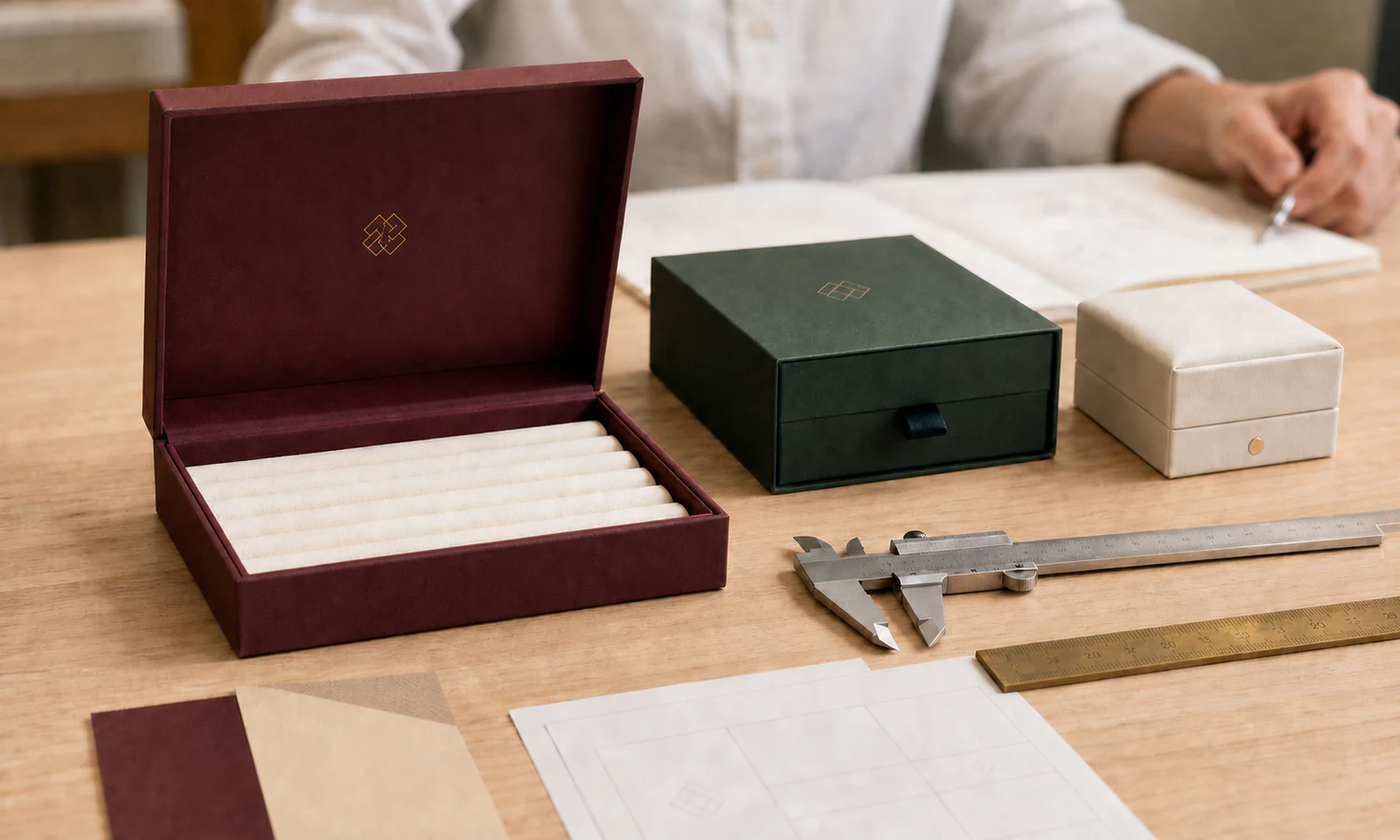
Common Jewelry Box Structure Mistakes
Choosing by the closed-box photograph
A closed photograph hides the opening action, insert clearance, lid stability, grip point, and packing steps. Always request open views and a normal-speed video.
Treating magnetic and hinged as mutually exclusive
A magnetic closure can be used on a connected, hinged lid. Define the complete construction instead of assuming that the two catalog labels describe separate engineering categories.
Selecting the box before confirming the jewelry and insert
The required depth, access, holding method, and lid clearance come from the product. A visually attractive exterior cannot correct an insert that presses the jewelry or makes removal difficult.
Assuming the presentation box is the shipping package
Drawer, magnetic, and hinged boxes still require channel-appropriate outer protection for e-commerce delivery. Test the complete pack-out.
Comparing quotations built around different specifications
If one quote uses a rigid magnetic box with a custom insert and another uses a paper hinged box with a standard insert, the prices do not represent the same solution. Align the brief first.
Approving the structure without the packing team
The person who designed the box may already know how to open and load it. New users reveal unclear actions, alignment problems, and training needs more effectively.
Frequently Asked Questions
Are magnetic jewelry boxes better than hinged jewelry boxes?
Not automatically. “Magnetic” describes a closure, while “hinged” describes a connected lid, and one box can have both. Compare the exact construction, jewelry fit, opening action, branding, packing workflow, storage, and full pack-out before choosing.
Are drawer jewelry boxes suitable for e-commerce shipping?
They can be used as presentation boxes within an e-commerce packaging system, but the drawer and jewelry still need appropriate outer protection. Test the complete box, insert, protective layer, mailer or carton, and expected handling conditions. Do not treat the presentation box alone as proof of shipping performance.
Which jewelry box style is best for rings, earrings, necklaces, or bracelets?
No single exterior structure is best for every jewelry type. Product dimensions, setting height, posts, chains, pendants, clasps, bracelet diameter, insert design, and removal method all affect the decision. Start with the jewelry and insert requirements, then compare box structures with sufficient clearance and access.
Which structure gives the most space for a logo?
Magnetic and drawer formats often provide broad outer panels, while hinged boxes can provide both an outer lid and an inner-lid branding area. The best location depends on how the box is held, opened, displayed, and photographed. Test the logo at final size on the actual material and construction.
Which jewelry box structure costs less?
There is no universal ranking. Dimensions, base material, covering, insert, closure, hinge or hardware, logo finish, quantity, sampling, assembly, individual protection, and shipping volume can all affect the quote. Compare suppliers against the same written specification.
Choose the Structure Around the Product and Workflow
Drawer, magnetic, and hinged jewelry boxes create different opening actions, but the catalog name should never be the final decision. Define the jewelry, insert, sales channel, branding, packing steps, storage, and shipping system first. Then review the construction in motion and approve a physical sample with a written specification.
A drawer may support a controlled reveal. A magnetic format may provide a clear closure and broad presentation surfaces. A hinged box may keep the lid connected and frame the jewelry when open. Each can work well when its structure supports the product and the people handling it.
To develop the box around your product dimensions, insert, opening style, material, and logo requirements, build your own jewelry packaging and prepare a clear brief for structure and sample review.